Is Cranfield the right place for you? We host and attend a range of events virtually, on campus, and around the world!
Ways to meet us
If you would like to discuss available scholarships, please get in touch with the Deputy Course Director, Dr Stefano Mori
Prepare to lead advanced mechanical engineering in a world shaped by energy transition and industrial complexity.
The Advanced Mechanical Engineering MSc is designed for high-calibre engineers seeking to develop the advanced technical depth and analytical capability required to address complex, real-world engineering challenges. The course is firmly grounded in the principles of rigorous mechanical engineering, with a strong emphasis on energy engineering as a key area of global industrial demand. You will develop advanced competence in modelling, analysis, and system-level engineering design, and apply these skills through industry-relevant modules and research-led projects. The focus is on developing engineers who can move confidently between theory, simulation, and practical implementation in demanding engineering environments. Alongside technical development, the course supports the growth of professional and leadership skills required to contribute effectively to complex engineering projects and multidisciplinary teams. Ranked in the UK top 5 for mechanical engineering, Cranfield University provides a specialist postgraduate environment with strong links to industry and a focus on applied engineering at scale. Students benefit from access to advanced experimental and computational facilities, supported by academic staff with extensive industrial and research experience. While the course has a defined focus in energy-centred mechanical engineering, students also benefit from the wider expertise available across Cranfield University, enabling the integration of multidisciplinary knowledge into group and individual research projects where appropriate.Overview
- Start dateFull-time: October. Part-time: October
- DurationOne year full-time; two-three years part-time
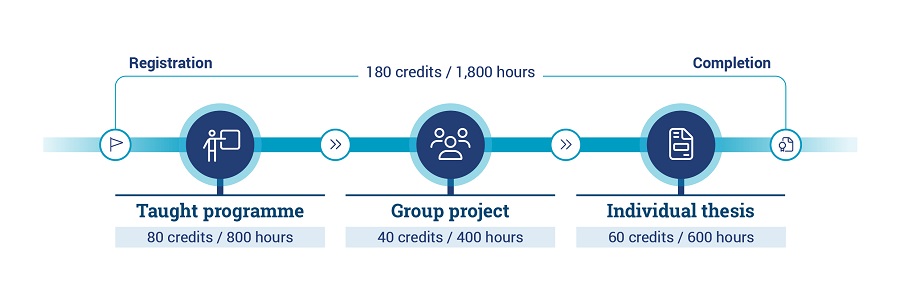
- DeliveryTaught modules 80 credits/800 hours, Group projects 40 credits/400 hours, Individual project 60 credits/600 hours
- QualificationMSc, PgDip, PgCert
- Study typeFull-time / Part-time
- CampusCranfield campus
Who is it for?
This course is intended for high-achieving graduates in engineering, physics, or mathematics seeking advanced training in mechanical engineering at postgraduate level. It is suited to those aiming for careers in advanced engineering design, analysis, and systems development within research-intensive or high-performance industrial environments.
You will develop advanced capability in computational and computer-aided engineering, structural mechanics and integrity, and system design and optimisation, alongside the ability to manage and deliver complex engineering projects. The focus is on building the technical depth and engineering judgement required for senior technical roles in industry, government, or research.
Your career
Career and employability are central to the Advanced Mechanical Engineering MSc. The course is designed to develop highly skilled graduates with advanced, industry-relevant expertise, positioning them as strong candidates for leading global employers.
You will gain transferable skills across key sectors including energy, aerospace, automotive, and manufacturing, and be well prepared for multidisciplinary roles that integrate mechanical and electrical engineering, particularly within energy systems and complex industrial environments.
A core focus of the course is ensuring you can make an immediate impact in your career. This is achieved through advanced technical learning combined with extensive opportunities to apply knowledge through industrially relevant group and individual research projects. Alongside technical depth, you will also develop essential professional capabilities such as technology leadership, innovation, and problem-solving.
Graduate Destinations
Our graduates have progressed into roles such as:
- Mechanical Engineer, Airbus
- Mechanical Engineer, Jaguar Land Rover
- Mechanical Design Engineer, Siemens
- Production Line Supervisor & Lean Implementer, GKN Land Systems
- Staff Engineer, BPP Technical Services Ltd (offshore oil and gas engineering)
- Engineer, Det Norske Veritas
- Management Associate, BMW Group UK Limited
- Project Engineer, BASF Coatings S.A
Cranfield Careers and Employability Service
Cranfield’s Career Service is dedicated to helping you meet your career aspirations. You will have access to career coaching and advice, CV development, interview practice, access to hundreds of available jobs via our Symplicity platform and opportunities to meet recruiting employers at our careers fairs. Our strong reputation and links with potential employers provide you with outstanding opportunities to secure interesting jobs and develop successful careers. Support continues after graduation and as a Cranfield alumnus, you have free life-long access to a range of career resources to help you continue your education and enhance your career.
Why this course?
This MSc integrates advanced mechanical engineering with the management and leadership capability required to deliver large, complex engineering projects. It is aimed at graduates seeking progression into high-level roles across industry, government, and research.
- Ranked in the UK top 5 for mechanical, aeronautical and manufacturing engineering.
- Develop technology leadership capability in collaboration with the Cranfield School of Management.
- Undertake individual and group projects aligned with your technical interests and career direction.
- Learn from academics with extensive industrial experience and active engagement in solving current engineering challenges.
- Access near-industrial scale facilities across energy and power, aerospace, automotive, transport and manufacturing engineering.
The course is supported by professorial staff leading research and innovation at the forefront of mechanical engineering.
Informed by Industry
The Advanced Mechanical Engineering MSc is closely aligned with industrial practice, ensuring graduates are prepared for the demands of advanced engineering roles across global sectors. The course is shaped through long-standing partnerships with leading organisations and sustained engagement with applied research and development.
Teaching is informed by active, industrially funded research, enabling authentic engineering challenges and case studies to be embedded throughout the programme. Core modules reflect current practice in structural mechanics and integrity, engineering design, computer-aided engineering, materials and corrosion, machinery operation and optimisation, and project management.
A dedicated Engineering Project Management module develops the organisational and leadership capabilities expected in professional practice, while student projects are frequently aligned with ongoing applied research activities, ensuring strong relevance to contemporary engineering challenges.
The course is developed with input from an Industry Advisory Panel comprising senior engineers and technical leaders from organisations including McLaren Racing, Airbus, Siemens, Hawkins & Associates, and Kent Engineering & Consulting, ensuring continued alignment with sector expectations and evolving skills requirements.
Course details
The Advanced Mechanical Engineering MSc is delivered through a carefully designed, intensive learning structure that reflects the demands of modern, industry-driven engineering practice.
For full-time students, the course is completed in one academic year. The taught component consists of eight modules delivered in two progressive phases: four core modules between October and December, followed by four further modules between January and March. This staged structure enables students to first build strong theoretical foundations before progressing to more advanced and applied areas of mechanical engineering.
Teaching is delivered in focused, immersive blocks of full-day sessions, supporting rapid knowledge development while maintaining academic depth and continuity. Between teaching periods, dedicated independent study time allows for reflection, assignment preparation, and exam readiness—fostering strong self-directed learning skills.
In the second half of the course, learning becomes increasingly applied and problem-based. Modules integrate laboratory sessions, industrial case studies, and collaborative group activities, enabling students to apply advanced engineering theory to complex real-world challenges. Assessment is based on applied assignments completed within the module delivery periods, reinforcing practical problem-solving and teamwork capabilities.
This structured progression leads naturally into the Group Project (March to May), where students work collaboratively on an industry-relevant engineering challenge, followed by an Individual Thesis Project (May to September), providing an opportunity for in-depth independent research and specialist development.
For part-time students, the course is designed with flexibility to support professional commitments. Students may choose to complete either the Group Project or an individual Dissertation route. The part-time study duration is typically two to three years, allowing learners to progress at a manageable pace while maintaining full engagement with the taught modules and project work.
Course Delivery
Taught modules: 80 credits (800 hours)
Group project: 40 credits (400 hours) - March to May
Individual thesis project: 60 credits (600 hours) - May to September
Part-time study duration: 2–3 years (flexible pathway; Group Project or Dissertation option available)
Course delivery
Taught modules 80 credits/800 hours, Group projects 40 credits/400 hours, Individual project 60 credits/600 hours
Group project
The group project runs from late February until early May and enables you to apply the skills and knowledge developed during the taught modules. It provides you with direct experience of bringing knowledge to bear on an industrially relevant problem that requires a team-based multidisciplinary solution. You will develop a fundamental range of skills required to work in a team including team member roles and responsibilities, project management, delivering technical presentations and exploiting the variety of expertise from each individual member. Industry involvement is an integral component for the group project, to give you first-hand experience at working within real life challenging situations.
In recognition of the fact that the modern design engineer cannot be divorced from the commercial world, you will provide a presentation and poster. This provides the opportunity to develop presentation skills and effectively handle questions about complex issues in a professional manner. All groups submit a written report and deliver a presentation to the industry partner.
Part-time students are encouraged to participate in a group project as it provides a wealth of learning opportunities. However, an option of an individual dissertation is available if agreed with the Course Director.
Recent group projects include:
- Preliminary design of an offshore floating wind turbine,
- Multi-disciplinary design of a high speed marine vehicle with aerodynamic surfaces,
- Design optimisation of the drive train for a vertical axis wind turbine,
- Conversion of consumer waste plastic into new plastics,
- Design specification of pilot scale 142 kWth air/rock,
- Thermodynamic modelling of using Ca-based sorbents for heavy metal emission control during contaminated biomass combustion,
- Conceptual and preliminary design of a SPAR for a 5 MW VAWT,
- OpenO&M: Optimising availability of floating wind turbines for increased safety,
- Investigation of severe slugging in pipelines.
Individual project
The aim of the individual research project, which takes place between May and August, is to provide you with direct experience in undertaking a research/development project in a relevant industrial or research area. It therefore offers the opportunity to apply your knowledge and skills and focus your interests in a particular area of interest. You will submit a research thesis and make a formal presentation of your findings to a panel of academics and industry experts.
For part-time students it is common that their research thesis is undertaken in collaboration with their place of work and supported by academic supervision.
Recent individual research projects include:
- Comparison of a panel method and Reynolds averaged Navier-Stokes (RANS) method to estimate the aerodynamic coefficients of a profile flying in ground effect,
- The stress shielding effect of cracks in loaded components,
- Review and modelling of heave and roll motion passive damping systems for offshore floating support structures for wind turbines.
Modules
Keeping our courses up-to-date and current requires constant innovation and change. The modules we offer reflect the needs of business and industry and the research interests of our staff and, as a result, may change or be withdrawn due to research developments, legislation changes or for a variety of other reasons. Changes may also be designed to improve the student learning experience or to respond to feedback from students, external examiners, accreditation bodies and industrial advisory panels.
To give you a taster, we have listed the compulsory and elective (where applicable) modules which are currently affiliated with this course. All modules are indicative only, and may be subject to change for your year of entry.
Course modules
Compulsory modules
All the modules in the following list need to be taken as part of this course.
Advanced Noise and Vibration Control for Energy Systems
| Aim |
Modern energy systems operate under increasingly demanding dynamic conditions. Excessive vibration and noise can reduce efficiency, accelerate fatigue failure, increase maintenance costs and generate environmental noise pollution. The transition toward sustainable energy technologies introduces new dynamic challenges such as lightweight structures, high rotational speeds, fluid–structure interactions, acoustic resonance in pipelines, and low-frequency noise emissions. The module provides students with specialist skills increasingly sought by employers in the renewable energy, offshore, and energy infrastructure sectors, where vibration and noise control are critical for regulatory compliance and operational performance. |
|---|---|
| Syllabus |
|
| Intended learning outcomes |
|
Artificial Intelligence for Sustainability
| Module Leader |
|
|---|---|
| Aim |
|
| Syllabus |
|
| Intended learning outcomes |
On successful completion of this module you should be able to:
|
Assessing Risk and Failure
| Module Leader |
|
|---|---|
| Aim |
|
| Syllabus |
|
| Intended learning outcomes |
On successful completion of this module a student should be able to: Assess and analyse appropriate approaches to the collection and interpretation of data, this will be illustrated through the example of critically evaluating analysis and corrosion monitoring techniques to select appropriate methodologies. Evaluate the impact of corrosion on the mechanical responses of structural materials and the impact of inhibition techniques on extending life Evaluate and select appropriate techniques and tools for qualitative and quantitative risk analysis and reliability assessment Analyse and evaluate failure likelihood and potential consequences, and develop solutions for control/mitigation of risks Discuss the role of codes and standards |
Component Design
| Module Leader |
|
|---|---|
| Aim |
This is a specialised module to advance your technical skills in industry prototyping design processes. This module will also introduce you to the facilities/workshops available at Cranfield. |
| Syllabus |
Design thinking and creativity, Collaborative innovation, Understanding the value and use of prototyping for innovation, Introduction to technology readiness levels (TRL’s), How to identify and write good requirement for design, Hands-on use of professional CAD/CAE software, Design skills workshops (sketching, CADCAE, mechatronics, 3D printing), Knowledge of advanced materials and processes (smart materials, bio-inspiration, nano & micro technologies, additive manufacturing). |
| Intended learning outcomes |
On successful completion of this module you should be able to: Prepare and write design specification requirements for a new product, service or system. Formulate, plan and build low fidelity prototypes using design best practice and agile innovation techniques. Critically evaluate industrial best practice tools and techniques for converting an idea into commercially viable solutions. Assess the value of technology readiness levels used as an innovation process. Examine creatively within a multi-disciplinary team using self and group reflective techniques. |
Computational Fluid Dynamics for Renewable Energy
| Module Leader |
|
|---|---|
| Aim |
To appraise existing Computational Fluid Dynamics (CFD) techniques and tools for modelling, simulating and analysing practical engineering problems related to renewable energy, with hands on experience using commercial software packages used in industry. |
| Syllabus |
|
| Intended learning outcomes |
On successful completion of this module you should be able to:
|
Engineering Design and Project Management
| Aim |
|
|---|---|
| Syllabus |
Project Management, |
| Intended learning outcomes |
On successful completion of this module you should be able to:
|
Engineering Stress Analysis: Theory and Simulations
| Module Leader |
|
|---|---|
| Aim |
This module brings together theories and computational practicalities of Finite Element Analysis (FEA). This combination enables you to use FEA for modern engineering purposes, whilst understand the underlying mechanics. You will be provided with step-by-step ABAQUS tutorials to get familiar with basic and advanced functionalities of this finite element software package. The lectures and hands-on practice will help you to develop strong FEA skills such as investigating the stress and strain distribution in complex geometries, components, and structures. |
| Syllabus |
Theory Introduction to stress analysis of components and structures, Ductile and brittle materials, Tensile test, Material properties, Complex stress and strain, Stress and strain transformation, Fracture and yield criteria, Plastic deformation, Introduction to Computer-Aided Engineering, FEA methodology, FEA procedure. Fluid-structure interactions. Simulation Introduction to ABAQUS, Types of elements, Integration points, Meshing, Mesh convergence, Visualisation, Results interpretation, Beam structures under static and dynamic loading, stress concentration in steel and composite plates, tubular assemblies, 2D and 3D modelling of solid structures, axisymmetry and symmetry boundary conditions, Stress and strain analyses subjected to different loading conditions, Prediction and validation of the stress and strain fields ahead of the crack tip. |
| Intended learning outcomes |
On successful completion of this module you should be able to:
|
Thermal Systems Operation and Design
| Aim |
|
|---|---|
| Syllabus |
Heat exchanger design and operation Refrigeration systems Heat Recovery and Thermal Storage Thermal system modelling |
| Intended learning outcomes |
|
Teaching team
You will be taught by internationally recognised, industry-active research academics from Cranfield University, each with a strong track record in advanced mechanical engineering research, innovation, and industrial collaboration. Teaching is further enriched by visiting lecturers from industry, ensuring strong exposure to current engineering practice and real-world applications.
To maintain close alignment with evolving industry needs and expectations, the course is guided by its own Industrial Advisory Committee, providing strategic input and ensuring the curriculum remains relevant, forward-looking, and industry-informed.
The Course Director is Dr Mostafa Ranjbar and the Deputy Course Director is Dr Stefano Mori.








Accreditation
This MSc award has been accredited by the Institute of Mechanical Engineers, under licence from the UK regulator, the Engineering Council as meeting the requirements for Further Learning for registration as a Chartered Engineer. Please note that accreditation applies to the MSc award, PgDip and PgCert (if offered) do not meet in full the further learning requirements for registration as a Chartered Engineer. The accredited MSc will meet, in part, the exemplifying academic benchmark requirements for registration as a Chartered Engineer. Accredited MSc graduates who also have a BEng (Hons) accredited for CEng will be able to show that they have satisfied the educational base for CEng registration.
How to apply
Click on the ‘Apply now’ button below to start your online application.
See our Application guide for information on our application process and entry requirements.
Cranfield has a lot of proper industrial connections with industrial experts as well as the various process industries, industry providers in technology, which belong to the energy category.
Right now, we are in the phase of the group project and are getting to see a lot of industrial expert engagement. We are having research collaborations with various labs, and we get to use and explore all the facilities available at Cranfield.
I have been part of a sponsored project by Network Rail, for my group project. So that was a good achievement, because getting a sponsored project is very competitive.
Having a sponsored project means that you get real life experiences, you get to see what is happening in the industry.
The highlight for me was definitely the group project – working in relation to wind turbines. We studied a new component used in the base and the foundations of wind turbine structures and it was just a fantastic experience. I worked with some really great fellow students and took on a bit of a leadership role that I found I really enjoyed.
The highlight of my course has been the amount of friends that I have made here. Also, the amount of skills that I've developed and the amount of networking opportunities that I've got being a Cranfield student. My advice to future students – make the most of what you have at Cranfield.
I am very happy with my time at Cranfield so far because in addition to learning different cultures, different and complementary ways of learning, this course has given me a real deepening of my scientific knowledge applied in the field of energy. In addition, the lecturers are real experts in their field. They provide high-level training and advanced research on materials, structures and implementation processes for energy and power.
The highlight for me was me individual research project. It was about rapid prototyping and 3D printing. As part of the project, I was able to build my knowledge around rapid prototyping and use the 3D printing machines.