The Centre for Material’s work with industry, research and courses underpin innovation in material engineering, development, reuse and component longevity. Applications for material design, characterisation and testing are pervasive, and can be found in nearly every sector, from AI and robotics to energy, aerospace, defence and the circular economy.
Real-world impact
Our students, academics and technicians couple the latest thinking in material science with state-of-the-art equipment to find material solutions to the world’s sustainability challenges. Ranging from how to transport, store and use hydrogen as a fuel, how to deliver faster processing speeds and lower power consumption, and how to create biodegradable medical equipment, to name just a few.
Our work spans discovering functional materials such as ceramics, metallics, intermetallic and self-healing polymers (vitrimers), to composite manufacture and testing for space and automotive industries, to developing nanomaterials for drug delivery. By understanding the material science, conducting advanced characterisation and material testing, we work to make, break and improve not just the end material for its specific application, but the process of creating it: to make it faster, cheaper and greener
Capabilities
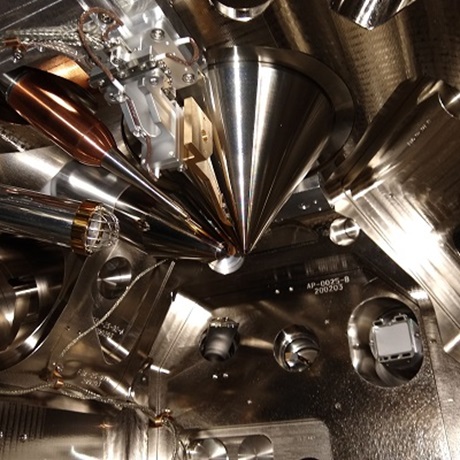
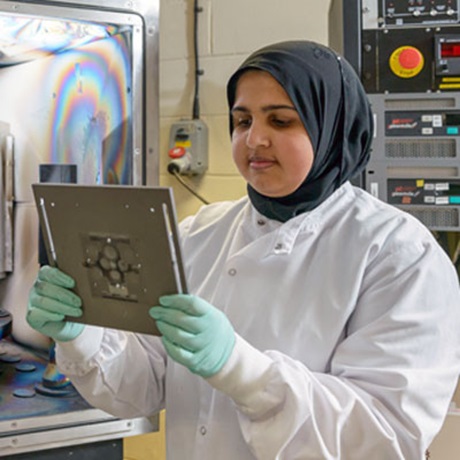
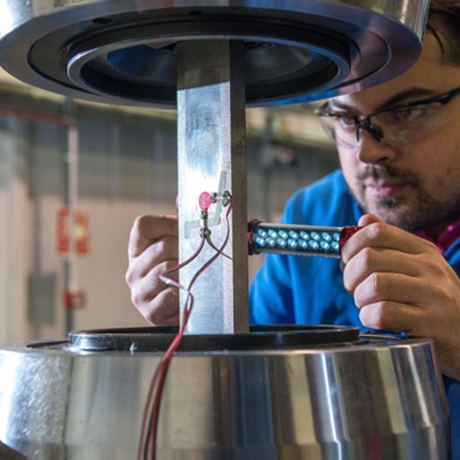
Cranfield’s Centre for Materials is home to world-leading, industrial-scale research facilities built in partnership with industry and underpinned by Government investment.
Business can access our equipment and expertise commercially, through a knowledge transfer partnership or through a Henry Royce Institute for Advanced Materials equipment access scheme (where applicable). This reduces capital expenditure in research and development and brings together commercial and academic expertise to solve society and industry’s challenges.
Download our Advanced materials facilities and expertise brochure for a brief overview of the services the Centre has to offer:
- Electrical testing suite,
- Electron microscopy suite,
- Environmental testing (temperature humidity UV) suite,
- Extreme temperature mechanical testing suite,
- Hydrogen testing suite,
- Metallography laboratory,
- Metrology and atomic force microscopy,
- Spectroscopy suite,
- Thermal rheological mechanical analysis suite (THERMMAT)
And browse the below facilities for more information: