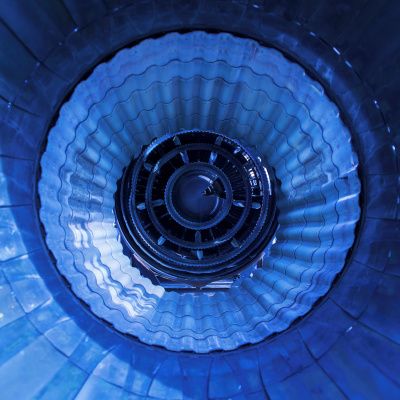
Cranfield University is playing a key role in a new £7 million aerospace research programme focused on developing the next generation of low-emission combustor technologies for future aircraft propulsion systems.
Project FALCON (Future Agile Architecture Low Emissions Combustor Module, Optimised with Novel Technology) is funded by the Aerospace Technology Institute (ATI) Programme, delivered in partnership with Innovate UK.
Led by ITP Aero UK, the £7 million collaborative programme brings together leading industrial and academic partners, including Wall Colmonoy Limited, Cranfield University and the University of Nottingham, to develop the next generation of combustor technologies for future aircraft propulsion systems.
FALCON will develop and validate a suite of innovative combustor technologies over a three-year period, progressing key concepts from early-stage research towards validated technology demonstrators. The programme is focused on delivering a scalable, agile combustor architecture capable of supporting future ultra-efficient and low-emission aircraft while strengthening sovereign UK design, manufacturing and testing capabilities.
Unique Cranfield facilities crucial to technology development
A series of bespoke test rigs will be hosted and operated at Cranfield University’s specialist research facilities as part of the FALCON programme.
Researchers will use these rigs to examine additively and conventionally manufactured SAF injector spray characteristics, combustor performance, emissions and altitude relight capability.
The Cranfield facilities to support FALCON testing include:
- The Power and Propulsion Labs, enabling liquid fuel spray characterisation under atmospheric conditions
- The pebble bed air heater combustion facility, characterising fuel sprays under engine representative elevated temperatures and pressures
- The pebble bed also enables testing under reacting flow conditions, so researchers can evaluate combustor performance and emissions
- The sub-atmospheric altitude test facility will evaluate the safety-critical ability of fuel nozzles and combustor systems to relight engines under conditions representative of flame-out at high altitudes, up to 30,000 feet.
Developing advanced technologies, skills and facilities for aviation
The research activity at Cranfield will enable the FALCON project to address some of the most pressing challenges facing the aerospace sector today, including supply chain resilience, manufacturing capacity, emissions reduction and the need to accelerate the development of propulsion systems compatible with sustainable aviation fuels (SAF) and future fuel technologies.
The programme will generate significant benefits for the UK aerospace sector, including safeguarding highly skilled engineering and research roles, creating new specialist positions and strengthening domestic supply chains for critical aerospace components. The project will also support the development of UK-based testing capabilities that reduce both development timescales and environmental impact associated with traditional combustion test programmes.
A major milestone in the future of UK aerospace
Dr Xiaoxiao Sun, Lecturer in the Low Emissions Technologies and Combustion group at Cranfield University said: “We are proud to embark on this journey towards sustainable aviation with ITP Aero by maturing both conventionally and additively manufactured combustion systems. Our unique combustion test facilities with state-of-the-art laser diagnostics and instrumentation will characterise SAF fuel sprays, combustion, and emissions at engine representative conditions.”
Cranfield University has pioneered extensive research into gas turbine technology, sustainable aviation fuels, propulsion systems and future low-carbon aviation. The University has a long-standing relationship with ITP Aero, collaborating on a number of major national and EU research and technology programmes, and via ITP Aero-funded MSc scholarships.
Rob Mitchell, Engineering Director, ITP Aero UK, said: "The successful award of FALCON represents a major milestone in ITP Aero UK's technology roadmap and an important investment in the future of UK aerospace.
“Working alongside our partners at Wall Colmonoy, Cranfield University and the University of Nottingham, we will accelerate the development of advanced combustor technologies that support the industry's transition to lower-emission aviation while strengthening UK sovereign capability.
“FALCON will help establish critical design, manufacturing and testing expertise within the UK, creating a platform for future growth and positioning ITP Aero UK to play a leading role in the development of next-generation propulsion systems."