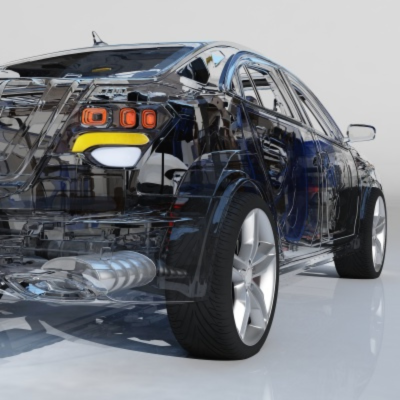
Car for On-Road Research on Automated Driving (CONRRAD) is a highly configurable, state-of-the-art research vehicle platform developed to enable real-time experimentation and validation of automated driving technologies. Combining drive-by-wire capability, a comprehensive sensor suite, and high-performance computing, it supports research in perception, planning, control, driver behaviour analysis, and driver monitoring.

Cranfield has an established track record in the development and evaluation of vehicle automation technologies, as well as in the analysis and monitoring of driving behaviour. CONRRAD represents the latest evolution of our automated vehicle demonstrator fleet. It is built on the robust and reliable platform of a production Kia Niro EV, enhanced with a gateway drive-by-wire system provided by Sygnal Auto. The platform has been engineered for flexibility, allowing straightforward maintenance and rapid integration of new sensors and components to meet evolving project requirements.
In its standard configuration, CONRRAD is equipped with a comprehensive sensor and computing suite, including:
- 1 × Ouster OS0-128 LiDAR sensor
- 4 × otoBrite cameras providing full surround vision
- 3 × Calyo ultrasonic sensors
- 1 × OxTS inertial navigation system with dual antennas and RTK correction
- High-performance computing hardware based on Intel PCs and NVIDIA Jetson platforms, enabling real-time execution of perception, planning, and control algorithms
In addition to vehicle automation, CONRRAD supports advanced studies of driver behaviour and human factors. The platform has been successfully deployed with a range of driver monitoring technologies, including heart rate monitors, EEG systems, eye trackers, and inward-facing cameras.
The vehicle’s dynamic behaviour has been rigorously characterised using Cranfield’s specialised facilities and expertise. High-fidelity vehicle models derived from this work support both simulation-based development and real-world validation of control strategies. All onboard sensors have undergone precise intrinsic and extrinsic calibration, enabling reliable data fusion and high-accuracy perception.
Building on this foundation, CONRRAD has been used to develop and demonstrate advanced capabilities such as 2D and 3D object detection, 3D mapping, and multi-sensor fusion. Our integrated solutions for perception, decision-making, trajectory planning, and trajectory tracking provide a state-of-the-art benchmark, supporting the evaluation and comparison of novel automated driving approaches.
Summary of applications
- Evaluation of novel perception systems
CONRRAD supports the assessment of emerging sensing technologies, as well as mapping, object detection, and sensor fusion algorithms, with straightforward comparison against state-of-the-art solutions. The platform has already been used to support the development of Calyo’s ultrasonic sensors within the Driven by Sound project (UKRI ref. 10059986). - Real-time validation of navigation algorithms
The platform enables real-time testing of decision-making, trajectory planning, and trajectory tracking solutions, building on a robust perception stack and a carefully validated vehicle model. CONRRAD has been extensively used to support similar activities on Group Design Projects within the MSc programmes in Automotive Mechatronics and Connected and Autonomous Vehicle Engineering. - Driver behaviour monitoring and analysis
CONRRAD facilitates in-depth investigation of driver behaviour using a combination of multimodal sensing technologies, including inward and outward-facing cameras, positioning and inertial systems, EEG, heart rate monitors, and eye tracking. This capability has been developed through projects such as HumanDrive, and further refined through ongoing research and teaching activities. - Investigation of Advanced Driver Assistance Systems (ADAS)
The platform enables research into next-generation ADAS, integrating information from the external environment, in-cabin sensing, and driver cognitive models. It also supports the application of force feedback to driver inputs, enabling studies on human-machine interaction and shared control. Relevant work has been carried out in collaboration with Jaguar Land Rover through the CogShift project.
The video presents an automated parking manoeuvre from the perspective of CONRRAD. The upper frames display the following views: the left-facing camera, the front-facing camera, and a camera monitoring the safety driver. The lower frame provides a comprehensive visualisation of the information available to our automated control system, including:
- A 3D model of the vehicle.
- The raw LiDAR output around the vehicle, shown in shades of green and red, where red indicates higher elevation points.
- The global path, represented by a blue line ahead of the vehicle, with annotations indicating local speed targets. The velocity profile is recalculated whenever an obstacle is detected along the path (for example, when a pedestrian crosses it). The path itself is regenerated once the vehicle comes to a stop in front of an obstacle.
- A static 3D map, shown in shades of pink around the perimeter of the proving ground. This map was generated offline using data collected with the same vehicle. Ground points have been removed to reduce scene complexity and data volume, which is why only the soil mounds at the edges are visible.
- The static costmap, displayed in blue and red around the edges of the proving area. This was manually labelled from the 3D map to define no-go zones and areas with different levels of traversability (for example, preferable versus permissible regions).
- The dynamic costmap, shown in the same colour scheme as the static one. This is generated in real time from LiDAR data and captures dynamic elements such as the movement of pedestrians.