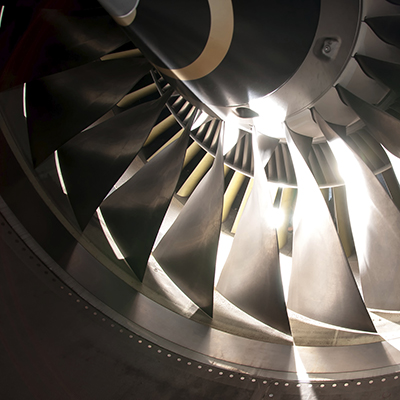
This is a fully funded PhD (fees and bursary) in propulsion system aerodynamics in collaboration with EPSRC, Rolls-Royce and Cranfield University. The measurement and evaluation of intake flow fields is a crucial aspect of powerplant integration, operability and performance. This applies to podded as well as embedded propulsion systems. The standard approach to measure non-uniformities of the intake flow is to use a relatively small number of total pressure probes ahead of the fan or compressor. It is acknowledged that this level of resolution is insufficient, but it is difficult to improve this using conventional intrusive measurements. Cranfield University has addressed this problem through non-intrusive particle image velocimetry (PIV) to measure the unsteady velocity field. This provides rich datasets with well resolved spatial and temporal measurements. The overall aim of this PhD project is to develop the next generation of advanced data analysis and characterisation methods for intake flow distortion based on synchronous pressure and velocity measurements and computational datasets.
The research will focus on the flow distortion that arises in a complex aero-engine intake. The project will build on previous successful programmes which have developed considerable expertise in the measurement of intake flow distortion using non-intrusive methods. The research will encompass rig design, aerodynamic measurements, and the development of advanced analysis methods for complex unsteady flows. A key part of the experimental research will be the synchronous measurement of velocity and total pressure. The project will investigate how machine learning and data-driven methods can be used to:
- Develop surrogate models that predict distortion metrics from sparse sensor measurements.
- Create reduced-order representations of complex intake flow fields using advanced data decomposition techniques.
- Identify, track and characterise coherent structures such as vortical distortion patterns.
- Fuse experimental PIV data, pressure measurements, and data from CFD simulations.
Overall, this will be a major advance on current experimental practice and will enable the assessment of the intake flow distortion in terms of the key elements that are known to affect the fan operability and performance. The successful candidate will work with unique experimental and numerical datasets and develop transferable skills in experimental aerodynamics, data analysis, machine learning, and computational methods.
The main impact of the work will be through Rolls-Royce where it will enable improvements to powerplant/airframe integration, aero-engine testing methods and compressor system operability. Unique opportunities for conference attendance, international workshops and industrial placements within Rolls-Royce are part of the programme.
The work will be conducted through the Rolls-Royce University Technology Centre based at Cranfield which has a strong collaborative history with Rolls-Royce in the area of aero-engine aerodynamics. This programme provides the PhD candidate with an outstanding opportunity to work closely with Rolls-Royce engineers across a range of disciplines for the development of future aerospace technologies and capabilities. During the PhD programme there will be regular reviews and presentation opportunities with Rolls-Royce as well as the chance to attend specialist MSc modules if needed.
At a glance
- Application deadline12 Aug 2026
- Award type(s)PhD
- Start date28 Sep 2026
- Duration of award4 years (full-time)
- EligibilityUK
- Reference numberCRAN-0065
Entry requirements
Applicants should have a first or second class UK honours degree or equivalent in a related discipline. This project would suit students with an aerospace or mechanical engineering background. Experience of experimental aerodynamics, particle image velocimetry, flow or aerodynamic measurements, compressible flow, CAD would be an advantage. As part of this role you may be required to obtain UK Security Clearance.
Funding
Sponsored by EPSRC, Cranfield University and Rolls Royce, this studentship will provide a starting bursary of up to £20,780 (tax free) plus fees* for four years.
To be eligible for this funding, applicants must be classified as a Home fee status student. Eligibility for Home fee status is determined with reference to UK Department for Education rules. As a guiding principle UK or Irish nationals who are ordinarily resident in either the UK or Republic of Ireland pay Home tuition fees. All other students (including those from the Channel Islands and Isle of Man) pay Overseas fees. Further advice can be found on the UK Council for International Student Affairs (UKCISA) website.
Diversity and Inclusion at Cranfield
We are committed to fostering equity, diversity, and inclusion in our CDT program, and warmly encourage applications from students of all backgrounds, including those from underrepresented groups. We particularly welcome students with disabilities, neurodiverse individuals, and those who identify with diverse ethnicities, genders, sexual orientations, cultures, and socioeconomic statuses. Cranfield strives to provide an accessible and inclusive environment to enable all doctoral candidates to thrive and achieve their full potential.
At Cranfield, we value our diverse staff and student community and maintain a culture where everyone can work and study together harmoniously with dignity and respect. This is reflected in our University values of ambition, impact, respect and community. We welcome students and staff from all backgrounds from over 100 countries and support our staff and students to realise their full potential, from academic achievement to mental and physical wellbeing.
We are committed to progressing the diversity and inclusion agenda, for example; gender diversity in Science, Technology, Engineering and Mathematics (STEM) through our Athena SWAN Bronze award and action plan, we are members of the Women’s Engineering Society (WES) and Working Families, and sponsors of International Women in Engineering Day. We are also Disability Confident Level 1 Employers and members of the Business Disability Forum and Stonewall University Champions Programme.
Cranfield Doctoral Network
Research students at Cranfield benefit from being part of a dynamic, focused and professional study environment and all become valued members of the Cranfield Doctoral Network. This Network brings together both research students and staff, providing a platform for our researchers to share ideas, identify opportunities for collaboration and create smaller communities of practice. It aims to encourage an effective and vibrant research culture, founded upon the diversity of activities and knowledge.
Doctoral Researchers’ Core Development (DRCD) Programme
An important part of the research journey is developing key skills that will benefit a research students research and professional development. As a research student at Cranfield, you will be expected to attend the DRCD programme which comprises of four 1 week units which cover the key stages of your research journey. Workshops are held face to face, providing the opportunity for you to network and collaborate with your peers during these valuable development sessions. For further details visit Cranfield's Doctoral Network.
How to apply
For further information please contact:
Name: Prof. David MacManus
Email: d.g.macmanus@cranfield.ac.uk
If you are eligible to apply for this studentship, please complete the online application form.
Please note that applications will be reviewed as they are received. Therefore, we encourage early submission, as the position may be filled before the stated deadline.