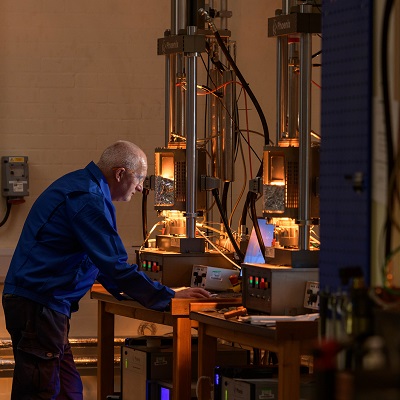
The Henry Royce Institute has been awarded a further £95 million in government funding for UK advanced materials research. This boost will extend the research projects Royce at Cranfield can deliver alongside small businesses, universities and major manufacturers.
That funding will extend the work Cranfield University is already doing to help organisations solve advanced materials problems that would otherwise be out of reach — from hydrogen permeation testing to AI-powered crack detection in turbine coatings.
As an Associate Partner of the Henry Royce Institute, Cranfield University offers businesses and researchers access to its National High Temperature Surface Engineering Centre, sharing world-leading equipment and expertise that most organisations can't justify buying or building themselves.
Dame Helen Atkinson, Deputy Vice-Chancellor of Cranfield University and a member of the Henry Royce Institute's Governing Board, said: "It is an accolade that Cranfield University is an Associate Partner of Royce, the UK's National Institute for Advanced Materials Research and Innovation. We welcome the announcement of this new tranche of funding and look forward to working closely as part of Royce going forwards".
De-risking innovation for small business
For smaller companies, Royce at Cranfield has helped drive new commercial products. Vicki Wilkes, Owner and Director of Darvick Ltd, worked with Royce at Cranfield to develop a first-of-its-kind hydrogen permeation testing rig. She explained, "it accelerated the technology development because having the funding has enabled us to de-risk that development [...] this capability would not exist without that backing."
Supporting university-led research
At a time when university research budgets across the UK are under growing strain, shared access to facilities like Royce at Cranfield is increasingly valuable. Equipment access schemes and industrial collaboration projects (ICPs) allow institutions to carry out advanced materials research without each having to fund costly equipment individually.
Royce at Cranfield has worked with a wide range of universities, including Loughborough University, the University of Southampton, Bangor University, Coventry University, City University and the University of Manchester.
A PhD student at Coventry University, for example, accessed Cranfield's multi-source electron beam and Chemical Vapour Deposition (CVD) equipment. Working with the team they deposited different types of thermal barrier coatings (used to protect turbine engine components from melting), to test how accurately AI could detect cracks in the coating during service conditions.
How can businesses and researchers access facilities?
Royce at Cranfield has worked with companies ranging from single-site start-ups to global manufacturers that rely on shared access to advanced testing infrastructure.
Businesses and researchers interested in accessing Royce at Cranfield's facilities can see the full list of facilities for materials and coatings for extreme environments and read our how to access materials science equipment FAQs page.