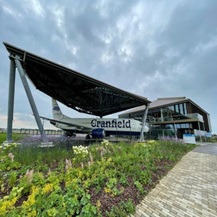
A UK airport trial has generated new operational evidence that could help the global aviation industry understand how hydrogen-powered ground equipment can be introduced safely and practically, and what is needed to support wider adoption.
Cranfield University is once again featured amongst the top universities in the world in the latest QS World University Rankings by Subject 2026, published today [25 March 2026].
Researchers at Cranfield University have created WANDER-bot, a low-cost, 3D-printed robot designed to spend extended periods exploring and mapping deserts, polar regions or even other planets.
A new test cell facility at Cranfield University’s campus, developed as part of the Cranfield Hydrogen Integration Incubator (CH2i) project, has been officially opened.
An airside hydrogen electric tug is now in operation at Cranfield Airport, in a significant development which is reducing carbon emissions and helping to prove hydrogen technologies in a working airport environment.
Researchers at Cranfield University have been conducting a study in partnership with Milton Keynes University Hospital using an AI-controlled robotic system to deliver echocardiograms.
Cranfield University has been awarded the prestigious Platinum level accreditation from the British Hedgehog Preservation Society, recognising its ongoing commitment to protecting hedgehogs and enhancing biodiversity across its campus.
Sir Andrew Haines has been appointed as the new Chair of Cranfield University’s Council. He will join the Council on 1 August and then take up the role of Chair in November 2025.
Cranfield has begun the first of multiple projects with sustainable aviation fuel (SAF) specialists CirculAIRity, a scale-up focusing on the use of SAF in aviation.