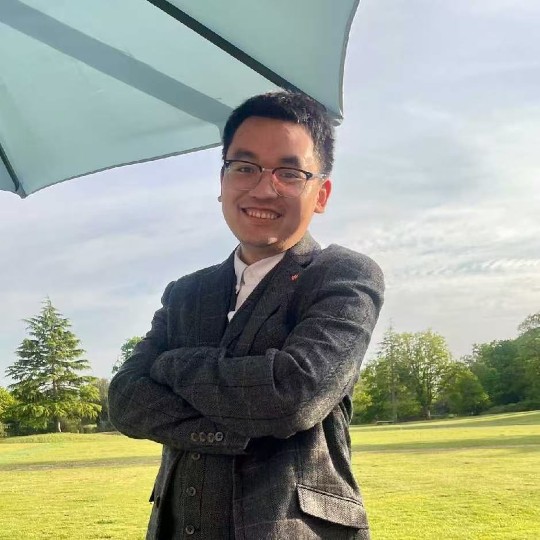
Contact Dr Xun Huang
- Email: Xun.Huang@cranfield.ac.uk
Background
Dr Xun Huang is a Postdoctoral Researcher at Cranfield University. He holds a BEng in Mechanical Engineering, an MSc in Aircraft Design, and a PhD in Aerospace Engineering. His research spans a range of aviation platforms, including bio-inspired micro aerial vehicles, large civil aircraft, and eVTOL aircraft, with a particular focus on integrating flight dynamics, intelligent control, aeronautical artificial intelligence, and engineering validation.
During his PhD, he investigated the dynamic modelling, flight control, and experimental validation of a bio-inspired hybrid flapping-wing rotorcraft, achieving sustained and stable flight control for this novel aerial vehicle. He is currently involved in the UK ATI LANDOne project, where his research focuses on artificial intelligence and assured autonomy for large civil aircraft, including intelligent braking, reinforcement-learning-based control, runtime safety assurance, and cross-simulator validation.
His work emphasises the integration of theoretical methods with real-world aerospace engineering requirements. He aims to establish a complete research framework spanning flight-dynamics modelling, intelligent algorithm development, multi-level simulation, and experimental validation, ultimately advancing aeronautical AI towards safe, trustworthy, and deployable engineering applications.
Research opportunities
Dr Xun Huang’s research interests lie at the intersection of flight dynamics, control engineering, artificial intelligence, and aviation safety. His principal research areas include:
1. Flight-dynamics modelling, intelligent flight control, and autonomous flight for bio-inspired aerial vehicles, micro air vehicles, and eVTOL aircraft;
2. Safety-critical control combining reinforcement learning, model predictive control, and runtime assurance;
3. Intelligent braking, fault-tolerant reconfiguration, assured autonomy, and certification-oriented validation for large civil aircraft;
4. Physics-informed machine learning, aeronautical world models, and digital twins integrating aircraft geometry, aerodynamic data, and operational flight data;
5. Surrogate modelling, system identification, uncertainty quantification, and data-driven prediction based on real-world flight data;
6. Cross-simulator transfer, Sim-to-Sim and Sim-to-Real deployment, hardware-in-the-loop testing, and flight-test validation;
7. Multimodal perception, computer vision, and AI-assisted piloting for aircraft operating in complex environments.
The overarching aim of his research is to develop next-generation intelligent aviation systems that combine learning and autonomous decision-making with physical consistency, interpretability, safety, and engineering verifiability.
Current activities
Dr Xun Huang is currently working as a Research Fellow at Cranfield University, focusing on artificial intelligence, assured autonomy, intelligent aircraft control, and safety-critical aerospace systems. His current and recent externally funded research projects include:
- ATI project — Research Fellow, funded by Airbus: Research on Artificial Intelligence and Assured Autonomy for Intelligent Landing, Taxiing and Braking Control of Next-Generation Aircraft (£35k), from 3 July 2025 to present.
- External project — Research Assistant, funded by Rolls-Royce: Single-Pilot Operation (SPO) Research relating to Engine Events (£100k), from 28 October 2024 to 29 September 2025.
- External project — Research Assistant, funded by Rolls-Royce: Liquid-Hydrogen Operation (LH) Research relating to Engine Events (£100k), from 29 April 2024 to 27 October 2024.
His current research involves developing and validating intelligent aircraft braking and ground-operation control systems that integrate reinforcement learning with runtime assurance. The objective is to maintain operational safety under uncertain environmental conditions, system failures, and other safety-critical scenarios.
He is also developing physics-informed and data-driven surrogate models based on operational flight data, with particular emphasis on
interpretability, physical consistency, uncertainty quantification, and event-level validation. His research further investigates cross-simulator deployment and validation, including Sim-to-Sim transfer, reinforcement-learning policy adaptation, and deployment across high-performance training environments and engineering flight simulators.
His broader activities include aeronautical world models and digital-twin technologies that integrate aircraft geometry, aerodynamic characteristics, flight dynamics, and operational data. Through these activities, he aims to establish an integrated pathway from AI model development and simulator-based evaluation to runtime safety assurance and engineering validation.
Publications
Articles In Journals
- Huang X, Lu L, Whidborne JF & Pavel M. (2026). Nonlinear model predictive control for hybrid flapping-rotor micro aerial vehicles. Journal of Guidance, Control, and Dynamics, 49(9)
- Huang X, Lu L, Whidborne JF & Pavel M. (2026). A bio-inspired hybrid flapping wing rotor for high-efficiency micro rotorcraft. CEAS Aeronautical Journal
- Pan Y, Guo S, Whidborne JF & Huang X. (2024). Aerodynamic performance of a flyable flapping wing rotor with dragonfly-like flexible wings. Aerospace Science and Technology, 148
- Pan Y, Guo S & Huang X. (2024). Research progress on bio-inspired flapping-wing rotor micro aerial vehicle development. Journal of Bionic Engineering, 21(4)
- Pan Y, Su H, Guo S, Chen S & Huang X. (2024). Analysis and testing of a flyable micro flapping-wing rotor with a highly efficient elastic mechanism. Biomimetics, 9(12)